
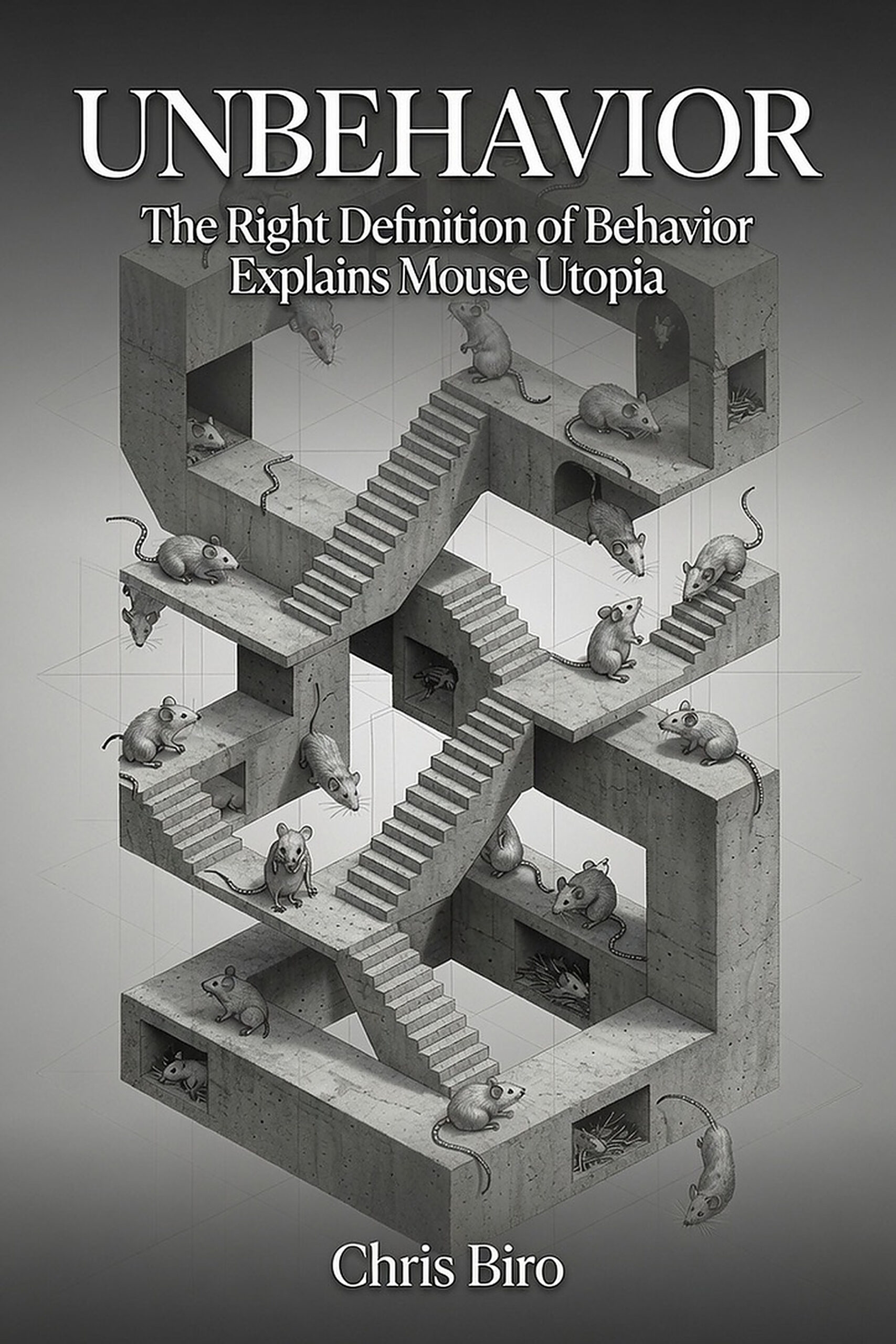
Description
Calhoun’s Universe 25, the “mouse utopia,” is one of the most retold experiments in behavioral science. The colony peaked at about 2,200 mice around day 560, in an enclosure with room for 3,840. About a fifth of the nesting boxes stood empty even at the peak. Then the colony stopped replacing itself, and mice moved to fresh enclosures at low density did not recover.
The usual explanation is crowding. Calhoun’s own data do not support it. UnBehavior returns to his 1973 report, sets aside what was exaggerated or borrowed from his earlier rat work, and asks what the data actually show.
The answer turns on a definition. Behavior is an action selected among available options, on the basis of stored consequence history, with the intent of producing a preferred outcome. Sever the link between what an animal does and what follows, and there is nothing left to choose between. What remains is unbehavior: the outward form of conduct, persisting after the thing that made it conduct is gone.
The final chapters turn to us: work made unnecessary, ownership thinning toward tenancy, schooling, credentials and debt. One difference from the mice is decisive. They could not diagnose their condition. We can.
Putting the mechanism to the test
Can the mechanism this book describes actually produce what happened in Universe 25? To find out, Chris Biro built software agents on the framework’s principles and raised some of them in a simulated “utopia” where nothing they did changed what happened to them, every need met, no matter what.
Two things happened, as the book predicts. The agents stopped treating food as important. And when consequences returned, they relearned food but stayed well behind agents with no experience at all, held back by habits they had built in a world without consequences. Agents without the ability to form habits showed no lasting cost.
A simulation can show that a mechanism can produce an effect, not that it is the one at work in real mice. But it puts the book’s central claim to a test anyone can check.
Read the one-page summary (PDF) · Code and full results, openly available: doi.org/10.5281/zenodo.23690120
The same simulation testbed has since been used to test the framework’s mechanisms in artificial intelligence: agents built on how animals decide what to ignore reached useful performance with about 40 times less computation than standard deep learning. Code and data: https://doi.org/10.5281/zenodo.23690120
Who this book is for
- Anyone who has heard of “mouse utopia” and wants the real story
- Readers wondering why having more hasn’t made people feel their lives matter more
- Students and professionals in behavior, psychology and ethology
Book details
Paperback: 6 × 9 in, 218 pages · ISBN 979-8-9958081-5-2
EPUB: ISBN 979-8-9958081-4-5
LCCN 2026922677
Publisher: Libertywings Publishing, McNeal, Arizona

Reviews
There are no reviews yet.