
Behavior, defined from first principles.
What is Applied Evolutionary Ethology? →
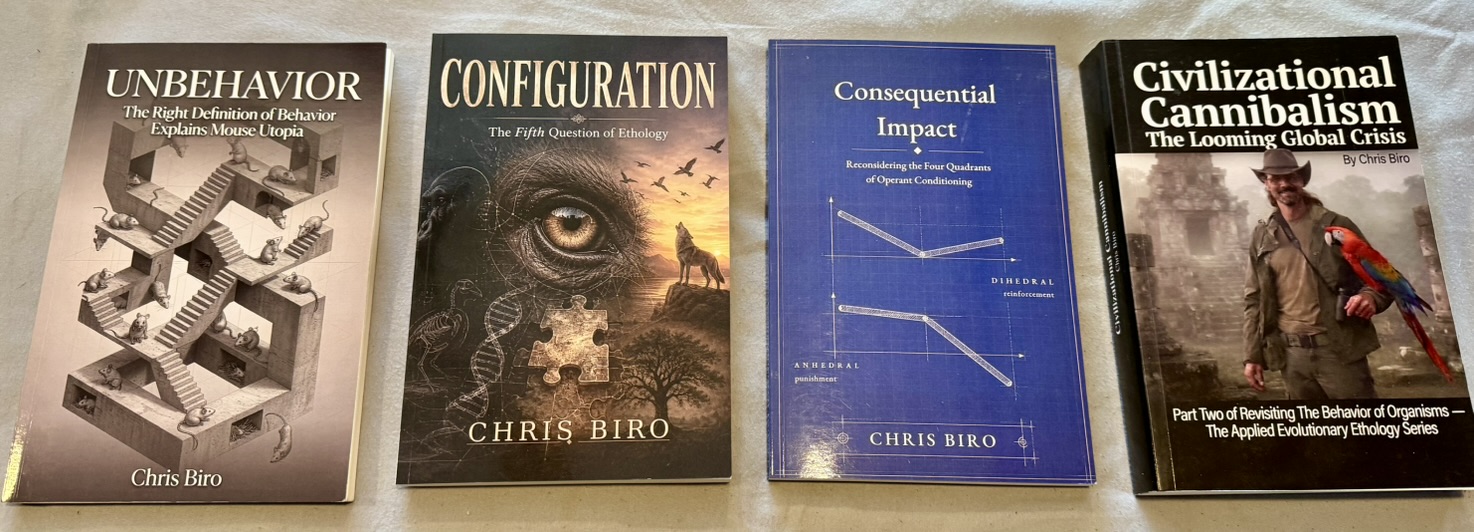
Chris Biro has flown parrots free since 1993: in his touring parrot show across the United States, in free-flight courses taken by students in 36 countries, and in conservation releases in Brazil and Colombia. That work kept running up against the same problem. Modern psychology and animal training theory describe behavior from the outside, as something observed and measured in an animal, with no account of what is going on inside the animal doing it.
This works up to a point. But nobody would claim to understand a computer by describing its keyboard, monitor and cables; understanding comes from knowing what goes on inside the machine. Something similar is true of behavior. Since Skinner, behavioral science has largely worked without that inside view.
The correction was already implied by the field’s own term. Operant Conditioning says the animal operates on its environment, and an animal that operates is after something of its own interests. What governs behavior is the animal’s self-interest. Consequences are one of the things it weighs, not the thing in charge.
Working from there, Chris identified the five major influences a handler has over behavior and the five core components of the behaving animal: body, personality, beliefs, emotions, and instincts. Together they describe the core of an internal framework, not an external record of what an animal did. The five volumes of this series develop it. Each one stands on its own.
The five core components
Behavioral science uses these words every day without workable definitions for them. The series defines each one, because a framework built on undefined terms can’t be tested.
- Body: the physical animal, which adapts while young in ways an adult cannot.
- Personality: observable patterns of behavior, run on autopilot from what the animal has learned.
- Beliefs: the animal’s working model of what works and where it works.
- Emotions: the pre-conscious system that classifies everything the animal meets: things to ignore, pursue, avoid, keep close, or escape.
- Instincts: inherited internal pressures that help cause behavior; they can be worked with or against, but not trained away.
These are short versions. Each term is defined in full, with the reasoning behind it, in the books and their glossaries.
The framework grew out of training animals, but it is not limited to them. The same structure applies wherever behavior occurs: in animals, in people, in the institutions and societies people build, and in artificial intelligence. The five volumes follow it across all of these.
The five volumes
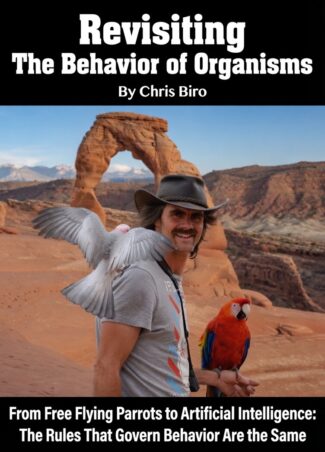
Each volume has its own job. One lays the framework down, one shows the failure it explains, one structures the answer, one supplies the tools, and one reads the whole thing at the scale of a society.



Where to start
Any of them. Each volume is a door into the same framework, and none assumes you have read the others.
- New to the ideas? UnBehavior. It is written for the general reader and starts from an experiment many people have already heard of.
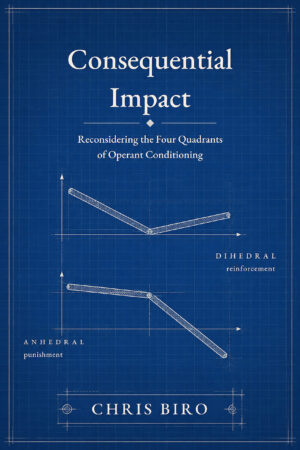
- A trainer or behavior professional? Consequential Impact, the volume that hands you tools.
- A biologist, or working on animal conservation releases? Configuration, the volume built on reintroduction work: preparing an animal for the world it will be released into.
- Want the whole framework in order? Revisiting The Behavior of Organisms (coming soon).
- Interested in society, culture, or where things are heading? Civilizational Cannibalism. It is not a book about politics. Densely written. It assumes no prior reading, but we recommend reading one of the other three first to become familiar with the core concepts.
The papers
The framework is also set out in a series of research papers, Because Definitions Matter, posted free on Zenodo as preprints, each with a permanent DOI. Start with the Reader’s Guide, which explains what each paper covers and suggests an order.
About the author
Chris Biro is a self-taught applied ethologist and the founder of Bird Recovery International. He has performed with parrots professionally since 1991 and has flown them free in his shows since 1993. His free-flight training courses have reached students in 36 countries. In 2022 he helped train and release six captive-bred Blue-and-yellow Macaws in southeastern Brazil; all six survived their first year without supplemental food, as reported in the peer-reviewed journal Birds (2024). He has since worked on parrot releases in Colombia. He breeds parrots, including the critically endangered Blue-throated Macaw and the Military Macaw, at his facility in the high desert of southeastern Arizona. The Applied Evolutionary Ethology series sets down the framework that three decades of that work produced.